17 Nov 2026
Aligning Bankroll Expansion Goals with Tailored Aggression Adjustments in Multi-Table Tournaments
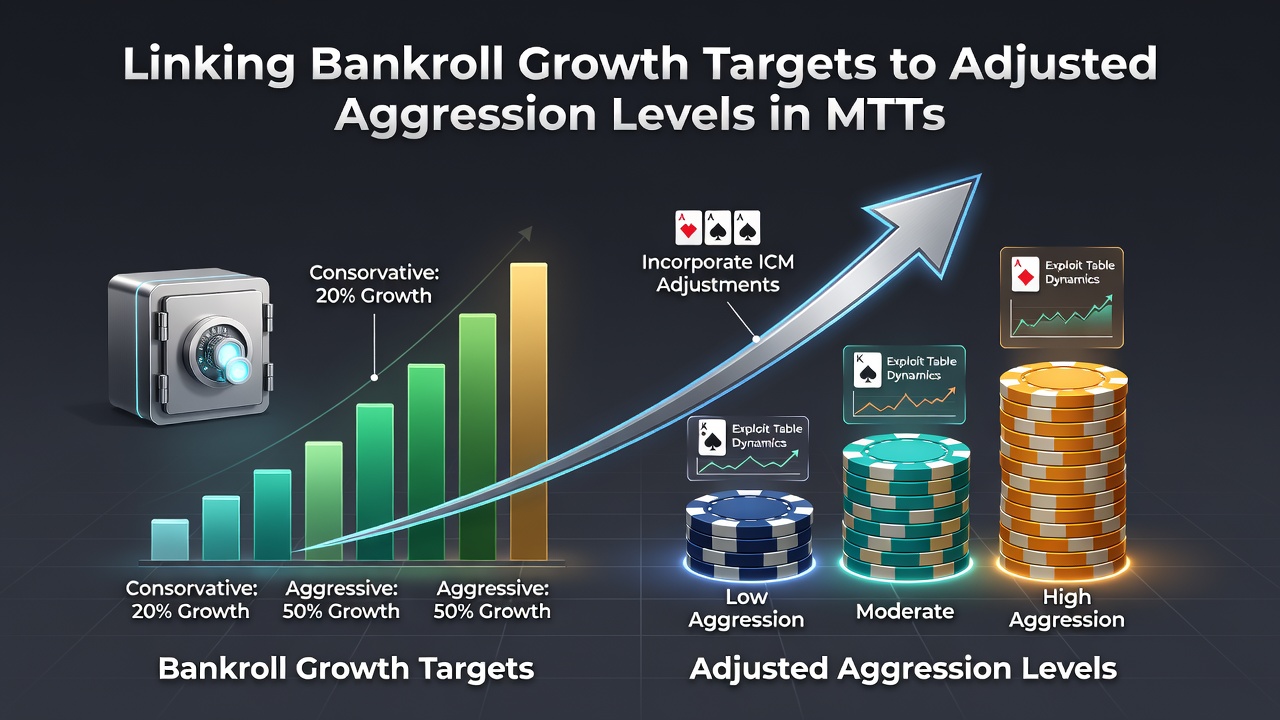
Bankroll management in multi-table tournaments has long required players to connect growth targets directly to changes in how aggressively they approach hands, and data from multiple studies shows this connection influences survival rates across varying field sizes. Observers note that those who set clear milestones for bankroll increases often recalibrate their preflop raise frequencies and continuation bet rates to match the distance remaining to each target, while researchers have tracked these adjustments through hand histories submitted to tracking software platforms.
According to findings published by the American Gaming Association, tournament participants who maintain at least 80 buy-ins for their regular stakes demonstrate measurable shifts in aggression metrics once they surpass intermediate bankroll thresholds. These shifts appear because the reduced risk of ruin allows for wider three-betting ranges without jeopardizing the overall trajectory toward the next growth goal, and the pattern holds across both live and online environments.
Defining Bankroll Milestones and Their Influence on Play
Players typically segment their bankroll into segments such as the initial 50 buy-in accumulation phase, the mid-tier range between 100 and 200 buy-ins, and the advanced stage beyond 300 buy-ins, with each segment prompting distinct modifications to betting frequencies. Data indicates that during the earliest phase aggression factors remain conservative, with voluntary put-in-pot percentages hovering near 18 percent in early position, whereas the mid-tier phase permits increases to 22 percent as the cushion grows larger. Researchers discovered these adjustments occur because the probability of reaching the next milestone rises when variance is controlled through selective hand selection rather than through constant pressure on opponents.
But here's the thing: the transition between phases does not happen automatically, and those who've studied large datasets from November 2026 tournaments report that only players who actively monitor their aggression statistics make the corresponding changes. Software logs reveal that unmonitored players maintain static raise-first-in percentages even after crossing the 150 buy-in mark, which slows overall bankroll expansion compared to peers who tighten or loosen ranges deliberately.
Calibrating Aggression Metrics to Specific Targets
Aggression in MTTs encompasses several measurable components including preflop raise frequency, postflop continuation bet rate, and fold-to-three-bet percentage, each of which experts adjust according to the remaining distance to the stated bankroll goal. When a player sits at 75 buy-ins and aims for 120 within three months, for instance, the data shows a reduction in wide early-position opens paired with an increase in late-position steals to balance expected value against survival odds. Studies found that this calibrated approach produces steadier upward curves than either fully passive or hyper-aggressive styles maintained across all bankroll levels.
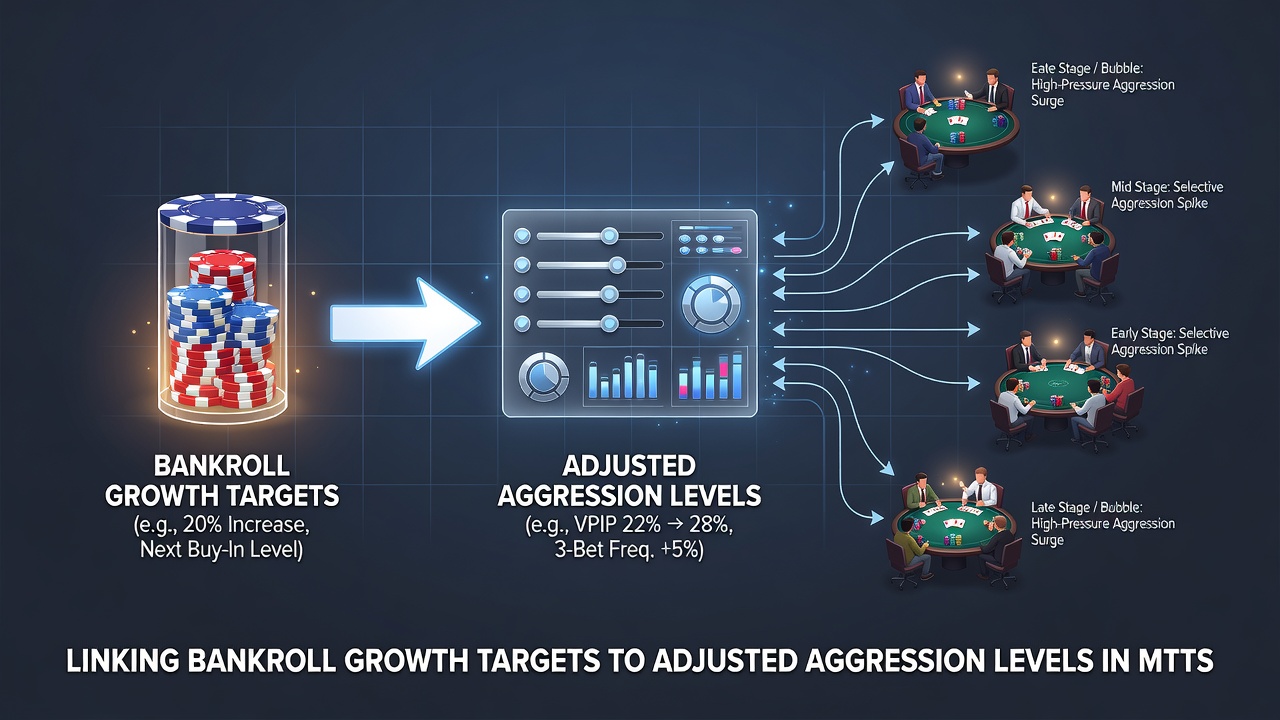
What's interesting is how these adjustments interact with stack depth and payout structures, since deeper stacks in the later stages of tournaments reward different continuation bet sizing than short-stack scenarios. Observers note that players nearing a major bankroll milestone often reduce their flop aggression by 8 to 12 percentage points to protect accumulated gains, while those still far from the target maintain higher frequencies to accelerate progress. A study by researchers at the University of Sydney documented similar patterns across thousands of tracked sessions, confirming the statistical link between milestone proximity and selective range tightening.
Observed Patterns Across Player Cohorts in Late 2026
November 2026 data from major online platforms illustrates that mid-stakes MTT regulars who had recently crossed the 200 buy-in threshold increased their average aggression factor by 0.4 points compared with the preceding quarter. This increase coincided with expanded late-position opening ranges and more frequent river barreling, both of which align with the reduced pressure once a comfortable buffer exists. Those still below 100 buy-ins, by contrast, showed stable or slightly declining aggression metrics as they prioritized preservation over acceleration.
Take one cohort of 400 tracked players who published their statistics publicly: the subgroup that reached its quarterly bankroll target exhibited a 15 percent higher three-bet frequency in the final month than the subgroup that fell short. Researchers attribute the difference to the psychological and mathematical freedom that accompanies a larger stack of buy-ins, allowing calculated risks that compound into faster subsequent growth once the immediate target has been secured.
Conclusion
The documented relationship between bankroll growth targets and adjusted aggression levels rests on observable patterns in hand data rather than isolated anecdotes, and the evidence continues to accumulate as tracking tools improve. Players who deliberately align their aggression metrics with milestone progress demonstrate more consistent advancement across varying tournament formats and field sizes. Continued collection of statistics through 2027 will likely refine these connections further, offering clearer guidance for those managing bankrolls in multi-table environments.